What is Quantum Entanglement?
Quantum entanglement is a unique and deeply mysterious phenomenon in which two or more qubits become so strongly correlated that the state of one instantly influences the state of the other — even when separated by vast distances.
Einstein called this “spooky action at a distance.”
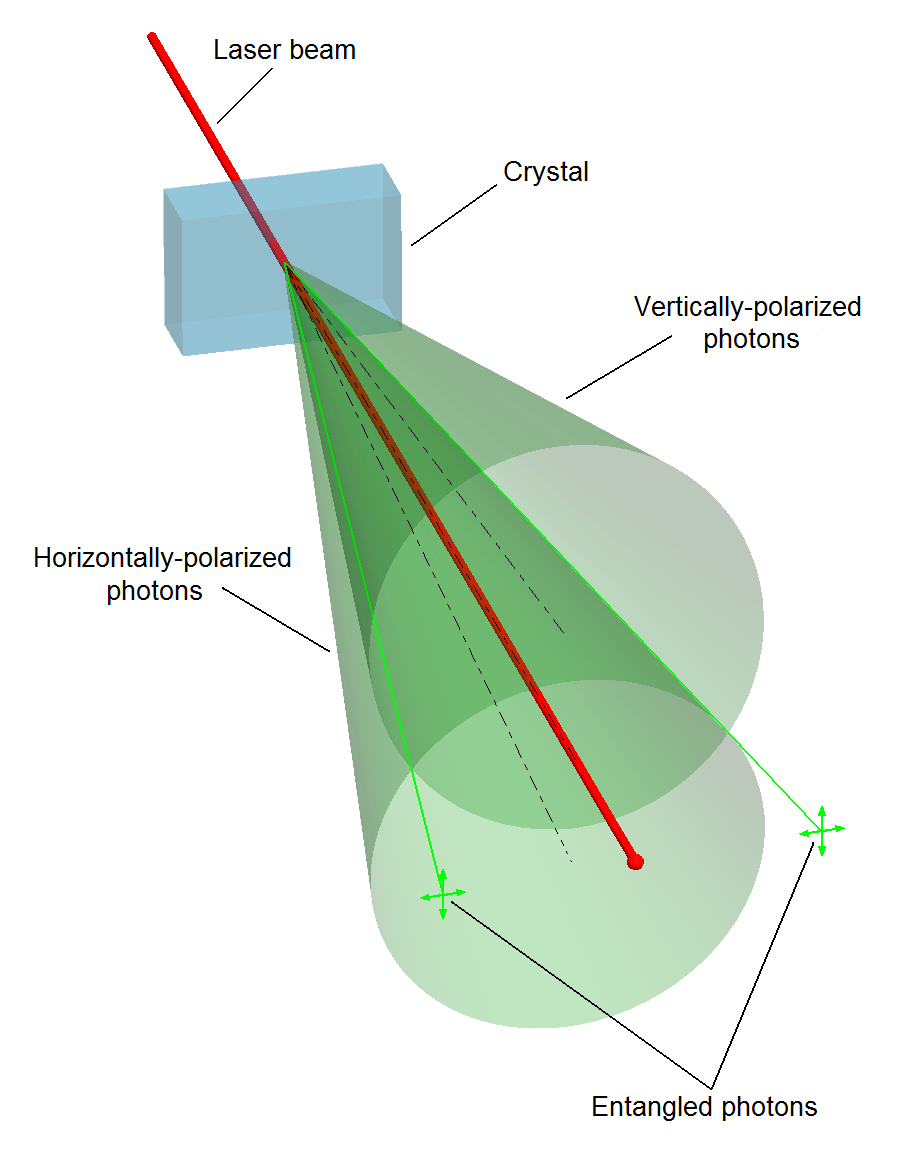
Illustration: Two particles remain correlated even across distance.
Bell States — The Simplest Entangled States
The simplest entangled pair of qubits is called a Bell state. One common Bell state is:
|Φ⁺⟩ = (|00⟩ + |11⟩) / √2
This means that if you measure one qubit and find it in state |0⟩, the other will also be |0⟩;
if the first is |1⟩, the second will also be |1⟩.
However, before measurement, both exist in a shared superposition.
Creating Entanglement with Qiskit
# Creating a Bell State with Qiskit
# pip install qiskit

from qiskit import QuantumCircuit, Aer, execute
from qiskit.visualization import plot_histogram
import matplotlib.pyplot as plt

# Create a 2-qubit, 2-classical-bit circuit
qc = QuantumCircuit(2, 2)

# Step 1: Apply Hadamard to the first qubit
qc.h(0)

# Step 2: Apply CNOT (entangles qubit 0 and 1)
qc.cx(0, 1)

# Step 3: Measure both qubits
qc.measure([0, 1], [0, 1])

# Simulate the results
simulator = Aer.get_backend('qasm_simulator')
result = execute(qc, simulator, shots=1000).result()
counts = result.get_counts()

print("Measurement Results:", counts)
plot_histogram(counts)
plt.show()
You should observe that the measurement results only contain 00 and 11 outcomes,
showing the **perfect correlation** between the two qubits — a hallmark of entanglement.
Applications of Entanglement
- Quantum Communication: Secure key exchange (E91 protocol)
- Quantum Teleportation: Transferring states using shared entanglement
- Quantum Algorithms: Speed-ups via correlated measurements
- Quantum Networks: Linking distributed quantum systems