What is a Qubit?
A qubit (quantum bit) is the smallest unit of quantum information —
the equivalent of a bit in classical computing.
While a classical bit can only be in one of two states, 0 or 1,
a qubit can be in a combination of both states simultaneously, thanks to the principle
of superposition.
|ψ⟩ = α|0⟩ + β|1⟩
where α and β are complex numbers and |α|² + |β|² = 1
Visualizing a Qubit: The Bloch Sphere
The Bloch sphere is a 3D representation of a qubit’s state.
The north pole represents |0⟩ and the south pole represents |1⟩.
Any point on the sphere’s surface corresponds to a valid qubit state.
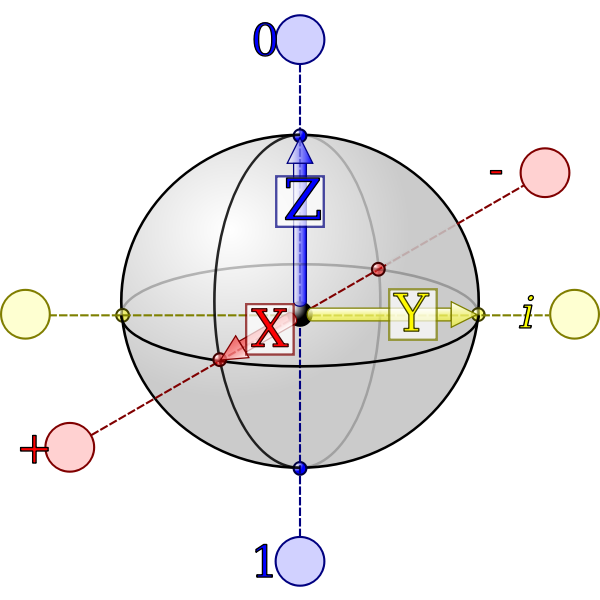
Visualization: A qubit in superposition on the Bloch sphere.
Superposition in Action
When we apply a Hadamard gate to a qubit initially in state |0⟩,
it transitions into an equal superposition of |0⟩ and |1⟩.
This means that until we measure the qubit, it’s effectively in both states.
# Visualizing a Qubit on the Bloch Sphere
# pip install qiskit qiskit[visualization]

from qiskit import QuantumCircuit
from qiskit.visualization import plot_bloch_multivector
from qiskit.quantum_info import Statevector
import matplotlib.pyplot as plt

# Create a circuit with 1 qubit
qc = QuantumCircuit(1)

# Apply a Hadamard gate to create a superposition
qc.h(0)

# Get the statevector
state = Statevector.from_instruction(qc)

# Plot on the Bloch sphere
plot_bloch_multivector(state)
plt.show()
This visualization shows the qubit pointing along the X-axis of the Bloch sphere —
halfway between |0⟩ and |1⟩ — representing an equal probability of
measuring either outcome.
Measurement: Collapsing the State
Once a qubit is measured, its quantum state collapses to one of the basis states,
|0⟩ or |1⟩.
The probability of each outcome depends on the square of its amplitude (|α|² and |β|²).
from qiskit import Aer, execute

# Add a classical bit for measurement
qc.measure_all()

# Simulate measurements
sim = Aer.get_backend('qasm_simulator')
result = execute(qc, sim, shots=1000).result()
counts = result.get_counts()

print("Measurement Results:", counts)
You’ll typically see results close to 50% 0 and 50% 1,
reflecting the probabilistic nature of quantum systems.
Next Concepts
- How two qubits can become entangled
- Quantum interference and constructive/destructive effects
- Multi-qubit systems and tensor products