Welcome to the Quantum World 🌌
The 20th century gave us the digital revolution. The 21st century will be shaped by the quantum revolution — where information is processed at the level of atoms, photons, and fundamental particles. This new paradigm of computing opens paths to simulate molecules, design advanced materials, secure communication, and accelerate AI.
— Viswa, Viswanext Quantum Initiative
How Quantum Computing Works
At its core, quantum computing leverages the behavior of nature itself. Instead of bits, which are binary (0 or 1), quantum computers use qubits, which can exist in superpositions — being both 0 and 1 until measured.
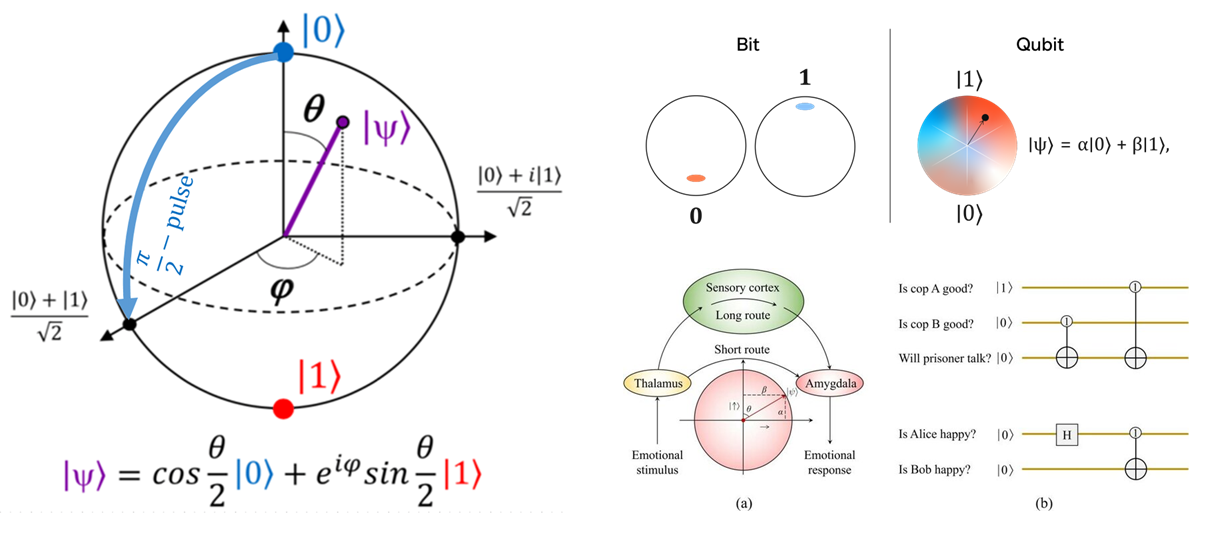
Illustration: A single qubit representing both 0 and 1 until observed.
Through entanglement, qubits can become linked so that changing one instantly affects another, even across distance — a property Einstein called “spooky action at a distance.” Quantum circuits use quantum gates to manipulate qubits into desired states, and when measured, we interpret their probabilities as outputs.
Quantum Advantage
Quantum advantage is achieved when a quantum computer can perform a task significantly faster than the best classical computers. For instance, Google’s 53-qubit processor “Sycamore” demonstrated a computation in 200 seconds that would take classical supercomputers thousands of years.
The Modern Quantum Landscape
As of 2025, quantum technology is no longer confined to labs. It’s emerging across:
- Cloud Platforms: IBM Quantum, Azure Quantum, Amazon Braket
- Hardware Leaders: Google, Rigetti, IonQ, PsiQuantum
- Software Frameworks: Qiskit, Cirq, PennyLane, Braket SDK
- Hybrid Systems: Combining quantum circuits with AI and HPC
Global organizations now run “Quantum-as-a-Service” offerings, allowing researchers and developers to test circuits on real hardware through the cloud.
Hands-on Example: Superposition Experiment
The following Qiskit example shows how to create a single qubit and place it in a superposition using a Hadamard gate:
# Install Qiskit if needed
# pip install qiskit

from qiskit import QuantumCircuit, Aer, execute

# Create a circuit with one qubit and one classical bit
qc = QuantumCircuit(1, 1)

# Step 1: Apply a Hadamard gate (H) to create superposition
qc.h(0)

# Step 2: Measure the qubit
qc.measure(0, 0)

# Step 3: Simulate the circuit
simulator = Aer.get_backend('qasm_simulator')
result = execute(qc, simulator, shots=1000).result()
counts = result.get_counts()

print("Measurement outcomes:", counts)
qc.draw('mpl')
Each run collapses the qubit’s wave function to either 0 or 1.
Over multiple runs, you’ll notice the results hover around a 50/50 split — a direct manifestation of quantum probability.
Quantum Reality: Beyond Binary Thinking
Quantum computation represents a **new way of reasoning about information** — probabilistic, relational, and parallel by nature. It doesn’t replace classical computing; it extends it into the probabilistic world of subatomic interactions.
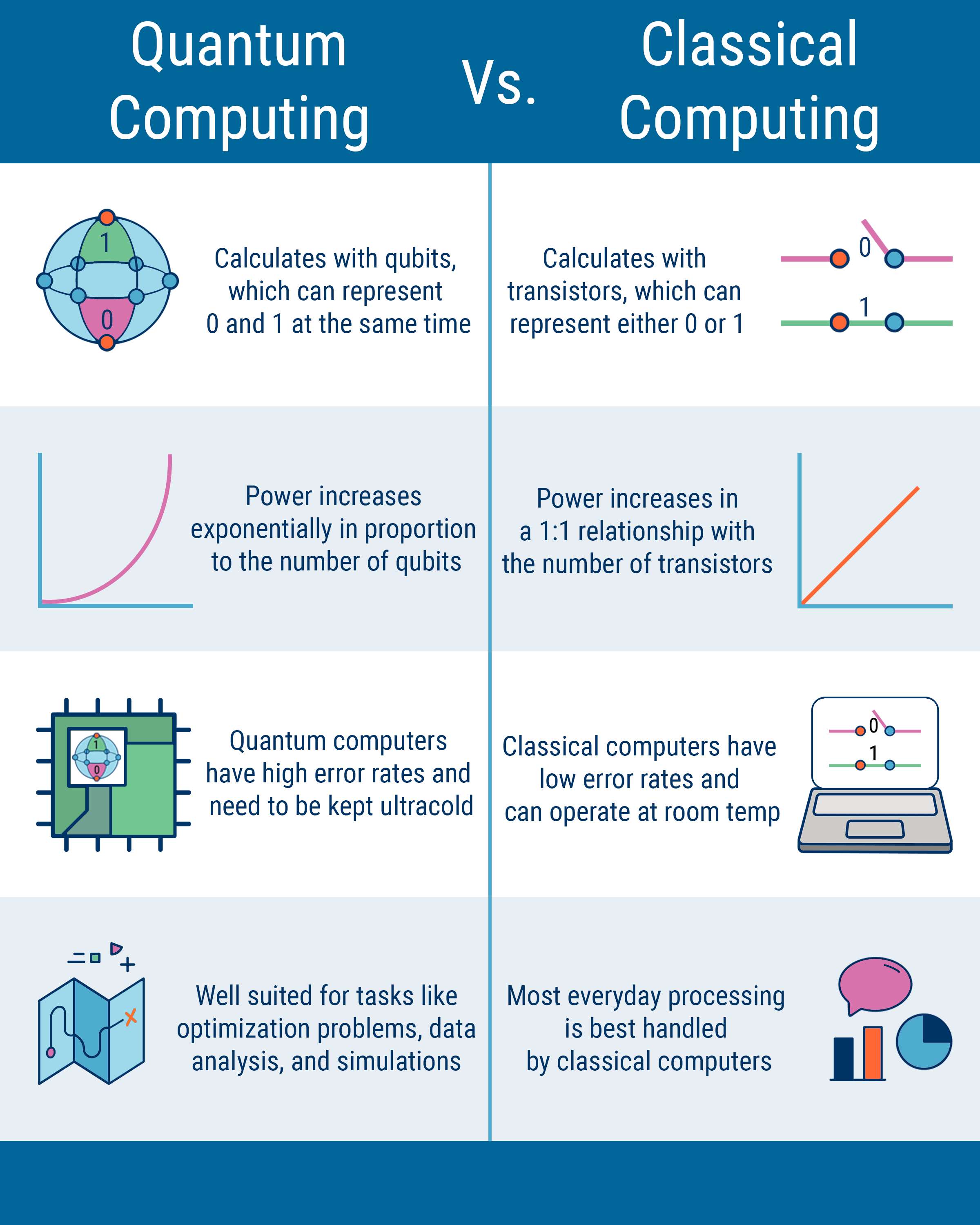
Visualization: Classical vs Quantum Information Processing
Further Reading & Exploration
- IBM Quantum Lab — Run circuits on real devices
- Qiskit Textbook — Free quantum learning resources
- Google Quantum AI — Hardware and research updates